NBA Teams Map: All 30 Teams, Cities and Arenas
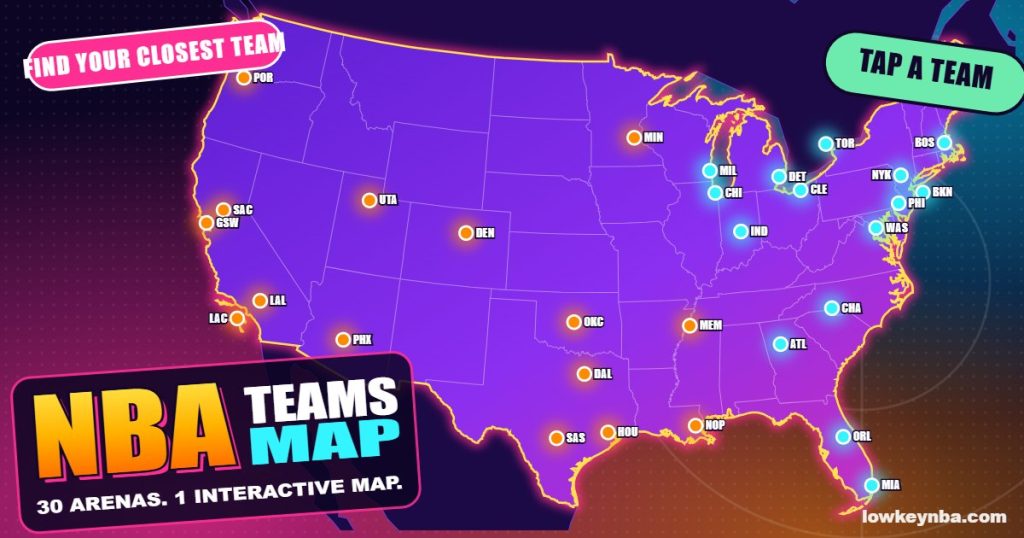
The NBA has 30 teams: 29 in the United States and one in Canada, the Toronto Raptors. They play in 21 states, Washington, D.C. and Ontario, split into the Eastern and Western conferences of 15 teams each. This NBA teams map shows the location of every NBA franchise and arena on a U.S. map, so you can see all 30 professional basketball teams and their cities at a glance. Last checked October 15, 2026.
That team’s arena, division and time zone will appear right here.
Distances are straight lines. A state uses its geographic middle, so pick the closest big city by location if you want an exact answer. Your location is used in your browser only and is never sent anywhere.
Arena to arena, in a straight line. The dashed line on the map is a connector, not a flight path.
Which team plays at the dark pulsing dot?
You get that franchise’s full history: every city and every name.
Each season is the one that starts in the year shown (1946 means 1946-47). Teams that folded during a season are still shown for that season. Dots that sit close together are spread apart a little so each one can be tapped.
NBA teams by conference and division
Each conference has three divisions of five teams. Arena names are the current ones; naming rights deals change often, so a few of these names are new.
Eastern Conference
| Division | Team | City | State or province | Arena | Arena opened |
|---|---|---|---|---|---|
| Atlantic | Boston Celtics | Boston | Massachusetts | TD Garden | 1995 |
| Atlantic | Brooklyn Nets | Brooklyn | New York | Barclays Center | 2012 |
| Atlantic | New York Knicks | New York | New York | Madison Square Garden | 1968 |
| Atlantic | Philadelphia 76ers | Philadelphia | Pennsylvania | Xfinity Mobile Arena | 1996 |
| Atlantic | Toronto Raptors | Toronto | Ontario | Scotiabank Arena | 1999 |
| Central | Chicago Bulls | Chicago | Illinois | United Center | 1994 |
| Central | Cleveland Cavaliers | Cleveland | Ohio | Rocket Arena | 1994 |
| Central | Detroit Pistons | Detroit | Michigan | Little Caesars Arena | 2017 |
| Central | Indiana Pacers | Indianapolis | Indiana | Gainbridge Fieldhouse | 1999 |
| Central | Milwaukee Bucks | Milwaukee | Wisconsin | Fiserv Forum | 2018 |
| Southeast | Atlanta Hawks | Atlanta | Georgia | State Farm Arena | 1999 |
| Southeast | Charlotte Hornets | Charlotte | North Carolina | Spectrum Center | 2005 |
| Southeast | Miami Heat | Miami | Florida | Kaseya Center | 1999 |
| Southeast | Orlando Magic | Orlando | Florida | Kia Center | 2010 |
| Southeast | Washington Wizards | Washington | Washington, D.C. | Capital One Arena | 1997 |
Western Conference
| Division | Team | City | State or province | Arena | Arena opened |
|---|---|---|---|---|---|
| Northwest | Denver Nuggets | Denver | Colorado | Ball Arena | 1999 |
| Northwest | Minnesota Timberwolves | Minneapolis | Minnesota | Target Center | 1990 |
| Northwest | Oklahoma City Thunder | Oklahoma City | Oklahoma | Paycom Center | 2002 |
| Northwest | Portland Trail Blazers | Portland | Oregon | Moda Center | 1995 |
| Northwest | Utah Jazz | Salt Lake City | Utah | Delta Center | 1991 |
| Pacific | Golden State Warriors | San Francisco | California | Chase Center | 2019 |
| Pacific | Los Angeles Clippers | Inglewood | California | Intuit Dome | 2024 |
| Pacific | Los Angeles Lakers | Los Angeles | California | Crypto.com Arena | 1999 |
| Pacific | Phoenix Suns | Phoenix | Arizona | Mortgage Matchup Center | 1992 |
| Pacific | Sacramento Kings | Sacramento | California | Golden 1 Center | 2016 |
| Southwest | Dallas Mavericks | Dallas | Texas | American Airlines Center | 2001 |
| Southwest | Houston Rockets | Houston | Texas | Toyota Center | 2003 |
| Southwest | Memphis Grizzlies | Memphis | Tennessee | FedExForum | 2004 |
| Southwest | New Orleans Pelicans | New Orleans | Louisiana | Smoothie King Center | 1999 |
| Southwest | San Antonio Spurs | San Antonio | Texas | Frost Bank Center | 2002 |
NBA team locations: where every team plays
The 30 NBA teams play in 30 arenas, with two teams each in the New York and Los Angeles areas. The NBA cities on the map are Atlanta, Boston, Brooklyn, Charlotte, Chicago, Cleveland, Dallas, Denver, Detroit, Houston, Indianapolis, Los Angeles (Lakers and Clippers), Memphis, Miami, Milwaukee, Minneapolis, New Orleans, New York, Oklahoma City, Orlando, Philadelphia, Phoenix, Portland, Sacramento, San Antonio, San Francisco, Salt Lake City, Toronto and Washington, D.C. NBA teams play in arenas rather than stadiums, so a map of NBA stadiums is really a map of these 30 arenas.
The usual read of the NBA map is that it leans toward the coasts and the east, and the numbers back that up. 13 of the 30 teams are in the Eastern time zone, 9 in Central, 5 in Pacific and only 3 in Mountain (Denver, Phoenix and Salt Lake City). 29 states have no team at all, and that includes most of the Great Plains and the Mountain West outside those three cities.
Part of that is population, and part of it is history. Franchises have moved toward bigger markets for decades, and the list of cities that lost teams below is long. Even the Toronto Raptors, the one team outside the U.S., are only about 340 miles from the Knicks, and they share the Atlantic Division with four Northeast teams.
A few facts from the arena coordinates: the Trail Blazers are the northernmost team and also the westernmost, the Heat are the southernmost, and the Celtics are the easternmost. The farthest pair is the Heat and Trail Blazers, about 2,704 miles apart in a straight line. The closest are the Nets and Knicks, about 5 miles apart.
NBA teams by state and province
California has four teams, Texas three, and New York and Florida two each. Every other team is the only one in its state or province.
| State or province | Teams | Who |
|---|---|---|
| California | 4 | Warriors, Clippers, Lakers, Kings |
| Texas | 3 | Mavericks, Rockets, Spurs |
| Florida | 2 | Heat, Magic |
| New York | 2 | Nets, Knicks |
| Arizona | 1 | Suns |
| Colorado | 1 | Nuggets |
| Georgia | 1 | Hawks |
| Illinois | 1 | Bulls |
| Indiana | 1 | Pacers |
| Louisiana | 1 | Pelicans |
| Massachusetts | 1 | Celtics |
| Michigan | 1 | Pistons |
| Minnesota | 1 | Timberwolves |
| North Carolina | 1 | Hornets |
| Ohio | 1 | Cavaliers |
| Oklahoma | 1 | Thunder |
| Ontario | 1 | Raptors |
| Oregon | 1 | Trail Blazers |
| Pennsylvania | 1 | 76ers |
| Tennessee | 1 | Grizzlies |
| Utah | 1 | Jazz |
| Washington, D.C. | 1 | Wizards |
| Wisconsin | 1 | Bucks |
NBA teams by time zone
| Time zone | Teams | Cities |
|---|---|---|
| Eastern | 13 | Boston, Brooklyn, New York, Philadelphia, Toronto, Cleveland, Detroit, Indianapolis, Atlanta, Charlotte, Miami, Orlando, Washington |
| Central | 9 | Chicago, Milwaukee, Minneapolis, Oklahoma City, Dallas, Houston, Memphis, New Orleans, San Antonio |
| Mountain | 3 | Denver, Salt Lake City, Phoenix |
| Pacific | 5 | Portland, San Francisco, Inglewood, Los Angeles, Sacramento |
Cities that lost an NBA team
The league started in 1946 in a mix of large and small cities, then consolidated and moved west and south. These are the moves that took a team out of a market. The gray dots on the map mark the seven cities that lost a team in the last 50 years, since 1976. Oakland and New Jersey sit next to cities that still have a team, so their gray dots are drawn slightly apart from the active team’s dot. Older moves that left a city without a team are listed here too. Every franchise move, including the ones inside one metro area, is in the franchise history section below.
| City | Team that left | Where it went | Year |
|---|---|---|---|
| Oakland, California | Warriors | San Francisco (still the Warriors) | 2019 |
| East Rutherford and Newark, New Jersey | Nets | Brooklyn | 2012 |
| Seattle, Washington | SuperSonics | Oklahoma City (now the Thunder) | 2008 |
| Vancouver, British Columbia | Grizzlies | Memphis | 2001 |
| Kansas City, Missouri | Kings | Sacramento | 1985 |
| San Diego, California | Clippers | Los Angeles | 1984 |
| Buffalo, New York | Braves | San Diego (later the Clippers) | 1978 |
| Cincinnati, Ohio | Royals | Kansas City and Omaha (later the Kings) | 1972 |
| San Diego, California | Rockets | Houston | 1971 |
| St. Louis, Missouri | Hawks | Atlanta | 1968 |
| Syracuse, New York | Nationals | Philadelphia (now the 76ers) | 1963 |
| Fort Wayne, Indiana | Pistons | Detroit | 1957 |
| Rochester, New York | Royals | Cincinnati | 1957 |
NBA franchise history: every move since 1946
Since 1946, NBA franchises have changed cities 23 times and 15 teams have folded. Press Time machine on the map above to watch the league change season by season: teams appear, fold and fly to new cities, and a tap on any dot gives that franchise’s full history. The count of moves includes moves inside one metro area, such as Oakland to San Francisco, and leaves out the two temporary ones: the Hornets in Oklahoma City after Hurricane Katrina (2005 to 2007) and the Raptors in Tampa during the COVID-19 border closure (2020-21).
The league started as the Basketball Association of America with 11 teams in 1946, grew to 17 when it merged with the National Basketball League in 1949, and shrank to 8 teams from 1955 to 1960. It reached 22 after the 1976 merger with the ABA and 30 when the Charlotte Bobcats joined in 2004.
Every NBA franchise move
| First season | From | To | Team today |
|---|---|---|---|
| 1951-52 | Tri-Cities Blackhawks (Moline, Illinois) | Milwaukee Hawks | Atlanta Hawks |
| 1955-56 | Milwaukee Hawks | St. Louis Hawks | Atlanta Hawks |
| 1957-58 | Fort Wayne Pistons | Detroit Pistons | Detroit Pistons |
| 1957-58 | Rochester Royals | Cincinnati Royals | Sacramento Kings |
| 1960-61 | Minneapolis Lakers | Los Angeles Lakers | Los Angeles Lakers |
| 1962-63 | Philadelphia Warriors | San Francisco Warriors | Golden State Warriors |
| 1963-64 | Chicago Zephyrs | Baltimore Bullets | Washington Wizards |
| 1963-64 | Syracuse Nationals | Philadelphia 76ers | Philadelphia 76ers |
| 1968-69 | St. Louis Hawks | Atlanta Hawks | Atlanta Hawks |
| 1971-72 | San Diego Rockets | Houston Rockets | Houston Rockets |
| 1971-72 | San Francisco Warriors | Golden State Warriors (Oakland) | Golden State Warriors |
| 1972-73 | Cincinnati Royals | Kansas City-Omaha Kings | Sacramento Kings |
| 1973-74 | Baltimore Bullets | Capital Bullets (Landover, Maryland) | Washington Wizards |
| 1977-78 | New York Nets (Uniondale, New York) | New Jersey Nets | Brooklyn Nets |
| 1978-79 | Buffalo Braves | San Diego Clippers | Los Angeles Clippers |
| 1979-80 | New Orleans Jazz | Utah Jazz | Utah Jazz |
| 1984-85 | San Diego Clippers | Los Angeles Clippers | Los Angeles Clippers |
| 1985-86 | Kansas City Kings | Sacramento Kings | Sacramento Kings |
| 2001-02 | Vancouver Grizzlies | Memphis Grizzlies | Memphis Grizzlies |
| 2002-03 | Charlotte Hornets | New Orleans Hornets | New Orleans Pelicans |
| 2008-09 | Seattle SuperSonics | Oklahoma City Thunder | Oklahoma City Thunder |
| 2012-13 | New Jersey Nets | Brooklyn Nets | Brooklyn Nets |
| 2019-20 | Golden State Warriors (Oakland) | Golden State Warriors (San Francisco) | Golden State Warriors |
NBA teams that no longer exist
All 15 folded in the league’s first nine seasons. Nine of them played only one season. No NBA team has folded since the Baltimore Bullets in 1954; today’s Washington Wizards, who played as the Baltimore Bullets from 1963 to 1973, are a different franchise.
| Team | City | NBA seasons |
|---|---|---|
| Toronto Huskies | Toronto, Ontario | 1946-47 |
| Cleveland Rebels | Cleveland, Ohio | 1946-47 |
| Detroit Falcons | Detroit, Michigan | 1946-47 |
| Pittsburgh Ironmen | Pittsburgh, Pennsylvania | 1946-47 |
| Providence Steamrollers | Providence, Rhode Island | 1946-47 to 1948-49 |
| Chicago Stags | Chicago, Illinois | 1946-47 to 1949-50 |
| St. Louis Bombers | St. Louis, Missouri | 1946-47 to 1949-50 |
| Washington Capitols | Washington, D.C. | 1946-47 to 1950-51 (folded in January 1951) |
| Baltimore Bullets | Baltimore, Maryland | 1947-48 to 1954-55 (folded in November 1954; 1948 champions) |
| Indianapolis Jets | Indianapolis, Indiana | 1948-49 |
| Anderson Packers | Anderson, Indiana | 1949-50 |
| Denver Nuggets (original) | Denver, Colorado | 1949-50 |
| Sheboygan Red Skins | Sheboygan, Wisconsin | 1949-50 |
| Waterloo Hawks | Waterloo, Iowa | 1949-50 |
| Indianapolis Olympians | Indianapolis, Indiana | 1949-50 to 1952-53 |
Will the NBA map change? Seattle and Las Vegas expansion
On March 25, 2026 the NBA Board of Governors voted to open the process of adding expansion teams in Las Vegas and Seattle, with a target start of the 2028-29 season. It was a vote to start the process, not to add the teams. Two more things have to happen: the league has to choose owners, and 23 of the 30 governors have to approve the final deal. Commissioner Adam Silver has said he wants a decision before the end of 2026.
As of October 15, 2026, the Las Vegas expansion bid is further along. Three ownership groups are reported to be bidding, and the reported price is $12 billion to $13 billion including a new arena. The Seattle expansion bid is behind: reporting describes it as waiting until Las Vegas is settled. If both cities get teams, the league would have 32, and league executives expect either the Timberwolves or the Grizzlies to move from the West to the East so each conference has 16. None of that is decided, which is why the map shows the Seattle and Las Vegas expansion candidates only when you tick the box.
NBA arena capacity, biggest to smallest
Seats for basketball. The league average is about 18,700.
Show the data behind this chart
Team
Arena
Capacity
Chicago Bulls
United Center
20,917
Washington Wizards
Capital One Arena
20,333
Detroit Pistons
Little Caesars Arena
20,332
Philadelphia 76ers
Xfinity Mobile Arena
20,007
New York Knicks
Madison Square Garden
19,812
Toronto Raptors
Scotiabank Arena
19,800
Miami Heat
Kaseya Center
19,600
Denver Nuggets
Ball Arena
19,520
Cleveland Cavaliers
Rocket Arena
19,432
Portland Trail Blazers
Moda Center
19,411
Dallas Mavericks
American Airlines Center
19,200
Charlotte Hornets
Spectrum Center
19,077
Los Angeles Lakers
Crypto.com Arena
18,997
Orlando Magic
Kia Center
18,846
Boston Celtics
TD Garden
18,624
San Antonio Spurs
Frost Bank Center
18,354
Utah Jazz
Delta Center
18,306
Oklahoma City Thunder
Paycom Center
18,203
Golden State Warriors
Chase Center
18,064
Houston Rockets
Toyota Center
18,055
Minnesota Timberwolves
Target Center
18,024
LA Clippers
Intuit Dome
18,000
Indiana Pacers
Gainbridge Fieldhouse
17,923
Memphis Grizzlies
FedExForum
17,794
Brooklyn Nets
Barclays Center
17,732
Sacramento Kings
Golden 1 Center
17,611
Milwaukee Bucks
Fiserv Forum
17,341
Phoenix Suns
Mortgage Matchup Center
17,071
Atlanta Hawks
State Farm Arena
17,044
New Orleans Pelicans
Smoothie King Center
16,867
New arenas on the way
Four current teams have a new arena under construction or proposed: the Thunder (Continental Coliseum in Oklahoma City, listed for 2028), the 76ers (a new South Philadelphia arena, proposed for 2030), the Mavericks (a new Dallas arena, proposed for 2031) and the Spurs (a new downtown San Antonio arena, proposed for 2032). The newest arena in use is the Clippers’ Intuit Dome, which opened in 2024.
Frequently asked questions
How many NBA teams are there?
There are 30 NBA teams: 29 in the United States and one, the Toronto Raptors, in Canada. They are split into the Eastern and Western conferences with 15 teams each, and each conference has three divisions of five teams. The league has been at 30 since the Charlotte Bobcats joined in 2004.
Which NBA team is not in the United States?
The Toronto Raptors, who play at Scotiabank Arena in Toronto, Ontario. The league also had a second Canadian team, the Vancouver Grizzlies, from 1995 until they moved to Memphis in 2001.
Which state has the most NBA teams?
California, with four: the Lakers, Clippers, Warriors and Kings. Texas has three (Mavericks, Rockets, Spurs), and New York and Florida have two each. Another 17 states plus Washington, D.C. and Ontario have one each, which leaves 29 states with no NBA team.
Which two NBA teams are closest together?
The Nets and the Knicks, whose arenas in Brooklyn and Manhattan are about 5 miles apart. The two Los Angeles teams are next, about 8 miles apart. Between different metro areas, the closest pair is the Warriors and the Kings, about 77 miles apart.
Which NBA teams are farthest apart?
Measured arena to arena in a straight line, the Heat and the Trail Blazers are the farthest pair, about 2,704 miles apart.
Will the NBA add expansion teams in Seattle and Las Vegas?
Not decided yet. On March 25, 2026 the Board of Governors voted to open the process of adding expansion teams in Seattle and Las Vegas, with a target start of the 2028-29 season. Commissioner Adam Silver has said he wants a decision before the end of 2026. Until the league approves new teams it has 30, and the map above shows both cities as proposed only.
Looking for the other end of the roster? See the tallest NBA players this season or search the 7-foot prospect database.
Is there a map of all NBA teams?
Yes. The interactive NBA teams map at the top of this page shows all 30 teams and arenas on a U.S. map. Tap a dot for the team, arena and division, switch to the closest team tool, or measure the distance between two teams. The New York and Los Angeles teams are drawn slightly apart so every dot shows; zoom in for their exact positions.
Where are all the NBA teams located?
The 30 NBA teams play in 30 arenas across 21 states, Washington, D.C. and Ontario. 13 are in the Eastern time zone, 9 in Central, 5 in Pacific and 3 in Mountain. The tables above list every team by city, state and arena.
Which cities used to have an NBA team?
Seattle (SuperSonics, until 2008), Vancouver (Grizzlies, until 2001), Kansas City (Kings, until 1985), San Diego (Clippers, until 1984) and Buffalo (Braves, until 1978) have no team today. Oakland (Warriors, until 2019) and New Jersey (Nets, until 2012) lost teams too but sit next to cities that still have one. They show as black circles with a red X on the map. Seattle and Las Vegas are also candidates for NBA expansion.
Which NBA teams no longer exist?
15 teams from the league’s early years folded, all between 1947 and 1954: the Anderson Packers, Baltimore Bullets, Chicago Stags, Cleveland Rebels, Denver Nuggets (the original team), Detroit Falcons, Indianapolis Jets, Indianapolis Olympians, Pittsburgh Ironmen, Providence Steamrollers, Sheboygan Red Skins, St. Louis Bombers, Toronto Huskies, Washington Capitols and Waterloo Hawks. The Baltimore Bullets were the last, folding 14 games into the 1954-55 season. No NBA team has folded since.
How many teams were in the first NBA season?
11. The league began in 1946 as the Basketball Association of America, which the NBA counts as its first season. Only the Boston Celtics and New York Knicks still play in the same city under the same name. The Philadelphia Warriors survive too, as today’s Golden State Warriors. The other eight teams folded.
Sources
Teams, divisions, arenas and coordinates: Wikipedia, National Basketball Association and List of NBA arenas, read October 15, 2026. Expansion: NBA press release and ESPN reporting from March 2026, and ESPN and Las Vegas Review-Journal reporting from October 2026. Distances are calculated from arena coordinates. Last checked October 15, 2026.